Tag: cruising tips

  • Mini Golf at Sea

    Mini Golf at Sea

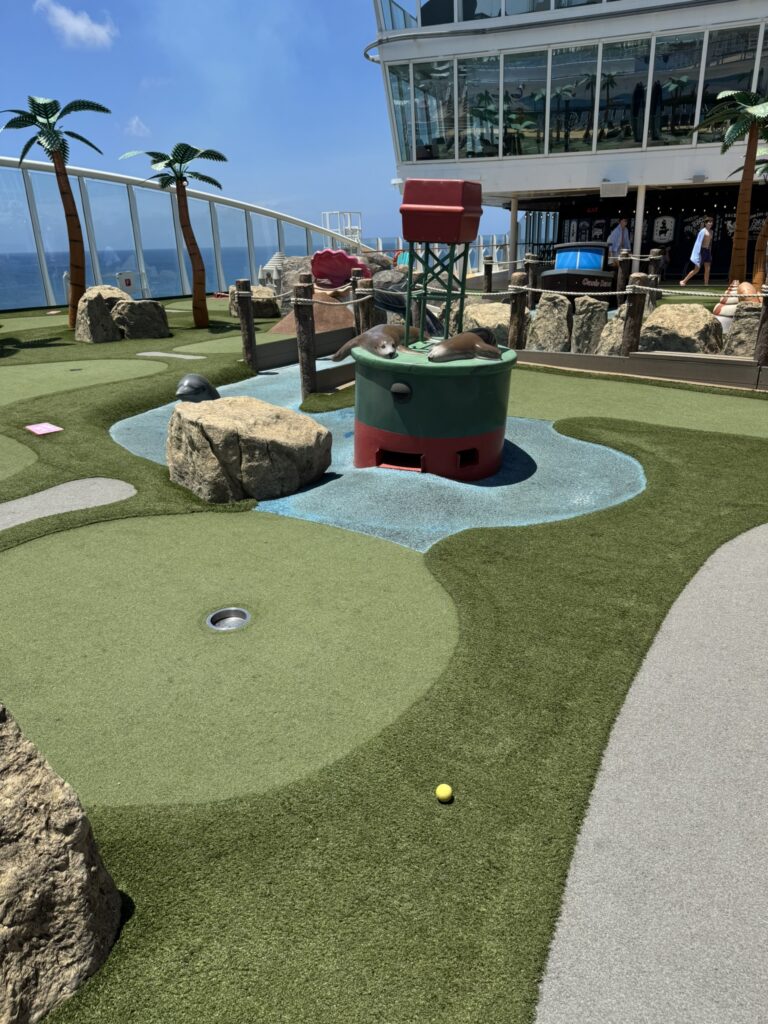
    Mini golf at sea course on a cruise ship deck with turf, rock obstacles, and ocean views.
    A bright and breezy moment of mini golf at sea, complete with ocean views and playful course details.

    Mini golf at sea is one of those classic cruise activities that blends fresh air, ocean views, and lighthearted fun in a way you can’t recreate on land. It’s completely free, open throughout the day, and easy to enjoy whether you’re traveling with kids, friends, a partner, or simply wandering the ship on your own.

    Why Mini Golf at Sea Is Such a Fun Cruise Activity

    Mini golf on a cruise ship feels playful and relaxing all at once. Families love it because it’s simple and kid‑friendly. Couples enjoy it as a fun break between meals and evening entertainment. Groups turn it into a friendly competition. And solo travelers can enjoy a peaceful round with nothing but the ocean breeze around them.

    The setting is what makes it special. Most courses sit high on the upper decks, giving you wide‑open views of the sea and sky. You can feel the breeze, hear the water, and watch the horizon stretch out in every direction. The gentle motion of the ship adds a quirky twist—your ball may roll a little differently than it does on land, which becomes part of the charm.

    Mini golf also fits perfectly into those in‑between moments of a cruise day. If you’re waiting for lunch, killing time before a show, or just want something fun to do after the pool, you can wander up for a quick round. There’s no schedule, no reservation, and no pressure—just grab a putter and start playing.

    Retro‑style “Oasis Dunes” surf van display on a cruise ship deck, surrounded by beach‑themed décor and ocean views.
    A fun themed element from the mini golf at sea course, featuring the retro “Oasis Dunes” surf van against bright ocean views.

    What to Expect on Cruise Ship Mini Golf Courses

    Cruise ship mini golf courses are designed to be colorful, whimsical, and approachable for all ages. You’ll usually find bright turf, themed obstacles, and playful décor—everything from tropical elements to nautical shapes to cartoon‑style features that make the course feel fun and inviting. Some ships keep things simple with straightforward putt‑putt holes, while others build more elaborate layouts with curves, ramps, and creative challenges.

    Equipment is always provided. Putters and balls are available right at the course, and you can help yourself anytime. Most courses are open from early morning until late evening, so you can play in the sunshine, at sunset, or even under the glow of deck lights at night.

    Crowds vary throughout the day. Sea days tend to be busiest, especially mid‑morning and early afternoon. If you prefer a quieter round, early mornings and late afternoons are usually the best times. Even when it’s busy, the atmosphere stays relaxed—everyone is there to have fun.

    Many mini golf areas sit near other outdoor attractions like sports courts, ping‑pong tables, rock‑climbing walls, or observation decks. It’s easy to turn a simple game into a full afternoon of deck‑side exploring.

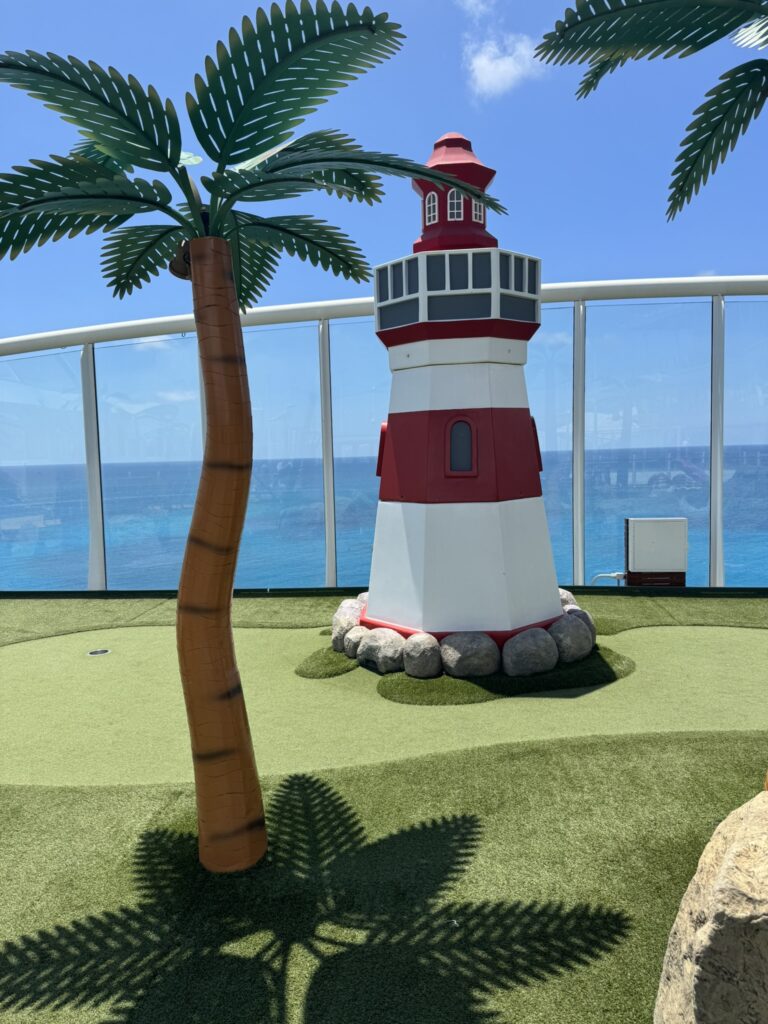
    Nautical‑themed mini golf at sea area on a cruise ship, featuring a lighthouse, palm tree, ship mast with a seagull, and a colorful signpost pointing to nearby attractions.
    A whimsical section of the mini golf at sea course, complete with nautical décor and playful themed elements overlooking the ocean.

    Tips for Enjoying Mini Golf on Your Cruise

    A few simple tips can make your mini golf experience even better. If you’re sailing somewhere breezy, try playing earlier or later in the day when the wind is calmer. Bring sunglasses and sunscreen, especially on sea days when the sun reflects off the water. If you’re playing with kids, let them take the lead—mini golf is one of the easiest ways to create fun family memories without any planning.

    If you’re traveling with adults, turn it into a friendly competition. Keep score, create mini challenges, or plan a rematch later in the cruise. Mini golf is also a great pre‑dinner activity—play a quick round before heading to the main dining room or your evening show.

    And don’t forget to look around. The views from the upper decks are often incredible, especially when the ship is sailing between islands or approaching port. Mini golf becomes more than a game—it becomes a moment to slow down, laugh, and enjoy where you are.

    Mini golf at sea has so many fun little details and themed touches scattered throughout the course, and each ship adds its own personality. These extra moments really bring the experience to life, so here’s a closer look at more of the playful scenes and creative elements you’ll spot as you make your way around the course.

  • Can You Cruise Without a Passport? (Closed‑Loop Cruise Rules Explained)

    Can You Cruise Without a Passport? (Closed‑Loop Cruise Rules Explained)

    Traveler holding a Canadian passport and boarding passes, illustrating the documents needed for cruise travel and when a passport is required.
    A passport is the most reliable document for cruise travel, especially if your itinerary requires international flights or unexpected changes.

    One of the most common questions new cruisers ask is whether you can cruise without a passport. The short answer is yes — sometimes. The long answer depends on your itinerary, your departure port, and how comfortable you are with the risks of traveling without one. While U.S. citizens can sail certain itineraries using a birth certificate and government‑issued ID, there are important exceptions and limitations to understand before you book.

    This guide breaks down when you can cruise without a passport, when you shouldn’t, and why having a passport is still the safest choice for most travelers.

    What Is a Closed‑Loop Cruise?

    A closed‑loop cruise is a sailing that starts and ends at the same U.S. port. Examples:

    • Miami → Caribbean → Miami
    • Galveston → Mexico → Galveston
    • Seattle → Alaska → Seattle

    For U.S. citizens, closed‑loop cruises allow more flexibility with travel documents.

    When You Can Cruise Without a Passport

    U.S. citizens can cruise without a passport on most closed‑loop itineraries if they have:

    • an original or certified copy of their birth certificate, and
    • a government‑issued photo ID (like a driver’s license)

    This applies to many:

    • Caribbean cruises
    • Bahamas cruises
    • Mexico cruises
    • Bermuda cruises
    • Alaska cruises that start and end in the U.S.

    Cruise lines accept these documents at check‑in, and U.S. Customs accepts them when you return.

    When You Cannot Cruise Without a Passport

    You must have a passport if:

    • your cruise starts or ends in a foreign country
    • your itinerary includes international flights
    • you are sailing to destinations that require passports for entry
    • you are taking a one‑way Alaska cruise (Vancouver → Alaska or reverse)
    • you are sailing from San Juan, Puerto Rico and flying internationally to get there

    If your cruise begins or ends outside the U.S., a passport is non‑negotiable.

    The Big Risk: Emergencies and Missed Ports

    Even if your cruise allows birth certificates, traveling without a passport comes with real risks.

    If you:

    • miss the ship
    • need medical evacuation
    • need to fly home from a foreign port
    • need to disembark early for an emergency

    …you cannot fly internationally without a passport.

    In these situations, you may be delayed for days while obtaining emergency documents from the nearest U.S. embassy or consulate.

    This is the #1 reason many cruisers choose to bring a passport even when it’s not required.

    What About Kids?

    Children under 16 can cruise on closed‑loop itineraries using:

    • an original or certified birth certificate
    • no photo ID required

    Teens 16–17 need:

    • a birth certificate
    • a government‑issued photo ID

    Passport rules for minors are the same as adults when flying internationally.

    Passport Book vs. Passport Card

    If you want a lower‑cost option, the passport card works for:

    • closed‑loop cruises
    • land border crossings
    • domestic flights (TSA‑approved ID)

    But it does not work for international flights.

    The passport book is the safest, most flexible option for all cruise travel.

    Should You Cruise Without a Passport?

    You can — but whether you should depends on your comfort level.

    Cruising without a passport may be fine if:

    • you’re on a simple closed‑loop Caribbean itinerary
    • you live within driving distance of the port
    • you’re comfortable with the limitations

    A passport is strongly recommended if:

    • you’re flying to your port
    • your itinerary includes multiple countries
    • you want maximum flexibility in an emergency
    • you’re traveling with kids and want a smoother process

    Final Thoughts

    Yes, you can cruise without a passport on many closed‑loop itineraries — but it’s not always the best choice. While a birth certificate and photo ID are acceptable for certain sailings, a passport gives you the freedom to fly home in an emergency, handle unexpected itinerary changes, and travel with confidence. If you cruise often or want the most flexibility, a passport is the safest and most reliable travel document to have.

  • REAL ID for Cruising: What It Is and When You Need It

    REAL ID for Cruising: What It Is and When You Need It

    Person holding up an identification card, illustrating what travelers need to know about REAL ID for cruising and how it affects flights to cruise ports.
    Understanding REAL ID for cruising helps travelers know when this type of ID is required for flights and when a passport is the better choice.

    REAL ID has caused plenty of confusion for travelers, especially as deadlines shift and states roll out compliant IDs at different speeds. If you’re planning a cruise, understanding REAL ID for cruising can help you avoid surprises when flying to your departure port or checking in at the terminal. The good news is that the rules are simpler than they seem once you break them down.

    This guide explains what REAL ID is, when you need it for cruising, and how it fits into your overall travel documents checklist.

    What Is REAL ID?

    REAL ID is a federal security standard for state‑issued driver’s licenses and identification cards. A REAL ID‑compliant license has a star in the upper corner and meets enhanced verification requirements.

    It’s designed to make identity documents more secure — but it doesn’t replace a passport, birth certificate, or any other cruise‑specific travel document.

    Do You Need a REAL ID to Board a Cruise Ship?

    No — you do not need a REAL ID to board a cruise ship.

    Cruise lines do not require REAL ID for:

    • closed‑loop cruises (departing and returning to the same U.S. port)
    • domestic sailings that do not involve air travel
    • presenting your passport or birth certificate at check‑in

    Your cruise documents depend on your itinerary, not your driver’s license.

    When REAL ID Does Matter for Cruising

    REAL ID becomes important when flying to or from your cruise port.

    Once the REAL ID enforcement date takes effect, you will need a REAL ID‑compliant license or another TSA‑approved document to fly within the United States.

    Examples of TSA‑approved alternatives:

    • U.S. passport
    • passport card
    • DHS trusted traveler card (Global Entry, NEXUS, SENTRI)
    • military ID

    So while REAL ID isn’t required for the cruise itself, it is required for the flight that gets you there.

    If You Have a Passport, You’re Already Covered

    If you’re cruising with a passport — which is always the safest choice — you don’t need a REAL ID for your flight. Your passport works as your TSA‑approved ID for domestic and international travel.

    This is especially helpful for:

    • Alaska cruises
    • Caribbean cruises requiring a passport
    • international embarkation ports
    • travelers who prefer one universal document

    REAL ID vs. Passport: What’s the Difference?

    DocumentPurposeWorks for Cruises?Works for Flights?
    REAL IDDomestic identificationNoYes (domestic flights)
    Passport BookInternational travelYesYes
    Passport CardLand/sea border crossingsYes (closed‑loop cruises)Yes (domestic flights)
    Standard Driver’s LicenseBasic IDYes (cruise check‑in)No (after REAL ID enforcement)

    REAL ID is not a replacement for a passport — it’s simply a more secure version of your driver’s license.

    Do Kids Need REAL ID for Cruising?

    No. Children under 18 do not need a REAL ID to fly with an adult. They also do not need a REAL ID for cruise check‑in.

    Their required documents depend on:

    • the cruise line
    • the itinerary
    • whether both parents are traveling

    But REAL ID is not part of the requirements for minors.

    How to Tell If Your License Is REAL ID‑Compliant

    Look for a star in the upper corner of your driver’s license. The star may be:

    • gold
    • black
    • white
    • outlined

    If your license has no star, it is not REAL ID‑compliant.

    Should You Get a REAL ID for Cruising?

    If you already have a passport, REAL ID is optional. If you don’t have a passport and plan to fly to your cruise port, REAL ID is helpful — but only for the flight.

    For most cruisers, the simplest approach is:

    • Use a passport for the cruise
    • Use the passport for the flight
    • Get REAL ID later if you want it for everyday use

    Final Thoughts

    REAL ID has caused plenty of confusion for travelers, especially as deadlines shift and states roll out compliant IDs at different speeds. If you’re planning a cruise, understanding REAL ID for cruising can help you avoid surprises when flying to your departure port or checking in at the terminal. The good news is that the rules are simpler than they seem once you break them down.

    This guide explains what REAL ID is, when you need it for cruising, and how it fits into your overall travel documents checklist.

error: Content is protected !!